


Why Blake Wesley is Crucial to the Portland Trail Blazers’ Success
- Juju

- Nov 4, 2025
- 3 min read
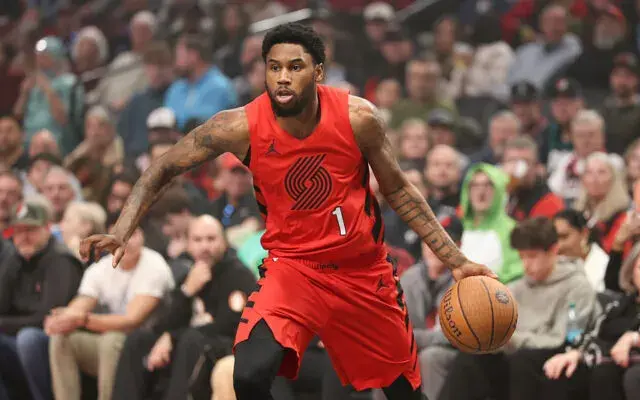
The Portland Trail Blazers have recently announced the sidelining of backup guard Blake Wesley, who went down with an injury versus the Denver Nuggets.
When looking at Blake’s career history, there isn’t anything that jumps out. Being selected by the Spurs in the 2022 draft, pick #25 never crossed the 5 point average mark in his 3 seasons with the team. He was known as a great energy and locker-room guy, but was noted as lacking in his offensive skillset. Eventually, he was traded to and waived by the Washington Wizards, after which he signed with the Blazers.
Blake’s speed was seen as one-dimensional, with many fans wondering about his future as a rotational guard. However, that speed is what is helping him thrive on the Blazers, helping contribute to a playoff pictured team ranked 3rd in pace. While his 6 points and 3 assists per game aren’t exactly eye popping, his basic stats don’t do him justice.
Wesley is a straight line driver, and one of the quickest players in the Association. He doesn’t entirely shift lanes, but he is good at getting past his man and decelerating, before looking for an open opportunity. The ball might swing once or twice again before going through the net, but it all comes from a breakdown initiated by Wesley’s speed and processing. This system works because the Blazers are surrounded by competent shooters, as well as good cutters like Avdija, Sharpe, and Camara.
Wesley’s not apt for finishing or shooting over great coverages, but you can’t just leave an NBA player an open lane to the rim regardless.
As a result, Wesley’s pace pushing in transition & open space sets is great. The Blazers rank 3rd in the league in pace, in which his 16 minutes per game are a crucial contribution. Blake holds a 114 Offensive Rating (via the NBA) thus far this season, a testament to his impact.
On defense, Blake’s efforts are noticeable. He’s a scrappy guard who doesn’t always get stops, but does fight through screens and recovers well to limit space. Sucking up space on-ball and slipping screens off-ball are Blake’s best talents on defense. He also loves to pick up full-court and swipe at the ball to pester ball handlers. As a result, Wesley holds an impressive average of 1.7 steals per game, good for 20th in the whole Association.
And while that may not result in the 6’4 guard getting isolation stops, it does help keep the Blazers’ top 5 defense steady. On a defense that focuses on relentless point-of-attack pressure, Blake continually makes life annoying for play initiators and easier for his team’s play disruptors.
Wesley’s absence was felt in tonight’s loss against the Los Angeles Lakers. This was evident in the Nuggets game after he went down, but the pace notably slowed down without him. And for a Blazers’ team that thrives in transition, this spelled trouble, as they aren’t a team built for consistent half-court offense.
Tonight, the Blazers tried rookie Caleb Love in the Blake Wesley role. For 7 minutes, Caleb couldn’t fill either gap, often deferring the ball to Avdija. On offense, he lacked the speed of Wesley, resulting in the loss of those breakdowns and transition buckets. Portland played against more set defenses, which has been a disadvantage for them.
On defense, Caleb picked up full-court and pestered like Blake. He did well to melt the shot
clock. But when sudden shifts or changes in directions were employed, Caleb got lost, and his recovery speed isn’t as fast as Wesley’s. Alongside some lethargic effort from Jrue, this led to a 25 point game for Nick Smith Junior, who shot 67% from the field and went 5/6 from 3-point range.
This leaves an obvious void in the Blazers’ backup guard and pace pusher role, with both Wesley and Scoot Henderson out for the time being. It remains to be seen how the Blazers will fill this gap. But what is being seen — and is clearer than ever in his absence — is the importance Blake holds for this young and hungry Portland team.


Comments